Gemini Watermark vs SynthID: What Is the Difference?
Gemini Watermark vs SynthID: What Is the Difference?
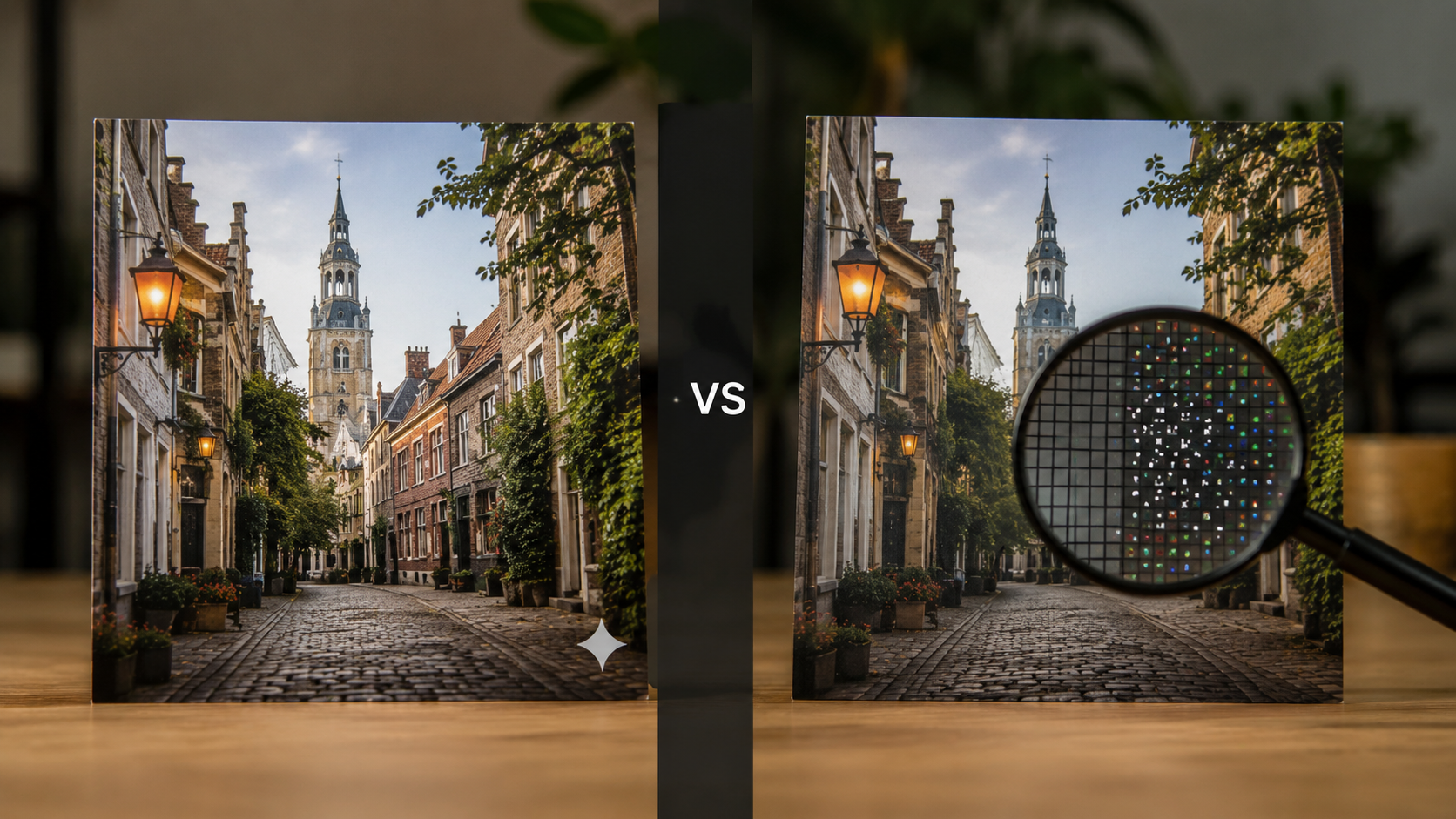
The fundamental difference between the Gemini watermark and Google SynthID lies entirely within the domain of visibility and technical application. The Gemini watermark is a visible, cosmetic, four-pointed star (sparkle) overlay anchored to the bottom-right corner of an image that is readily apparent to the human eye. Conversely, Google SynthID is a functionally invisible forensic digital signature embedded directly into the structural mathematical definition of the image pixels themselves; these two co-existing technologies are mathematically independent, applied at different stages of the content creation lifecycle, and serve distinct purposes within the generative AI ecosystem of 2026.
As generative AI integration transitions from a novelty to an absolute necessity in professional creative workflows, this technical divide is causing significant confusion. Visual professionals, marketers, and enterprises utilize Google's advanced imagery models, such as the high-speed Nano Banana variant (Gemini 2.5 Flash Image), to generate high-volume, production-ready assets. The conflict arises because while creative directors require clean, unbranded visuals for polished mockups and commercial campaigns, regulatory bodies mandate accountability. Understanding the difference between a cosmetic surface layer designed for human transparency and an invisible structural signature designed for computer verification is paramount for effective digital asset management and legal compliance.
The Visible Gemini Watermark - What It Is (The Cosmetic Layer)
To understand what is being visually stripped during content restoration, we must first analyze the visible layer. This element is the user-facing transparency mechanism mandated by Google content policies and modern regulatory guidelines like the EU AI Act context, designed to ensure synthetic media is immediately identifiable by a human viewer.
Anatomy and Properties of the "AI Sparkle"
Visually, this watermark appears as Google’s universally recognized symbol for artificial intelligence assistance: a semi-transparent, stylized, asymmetrical four-pointed star, commonly referred to as the "sparkle" or "glint." Technically, Google standardizes this as an alpha-composited transparency overlay rather than a solid, opaque graphic. The system dynamically applies a specific white tint or glow formula to this transparency mask. This standardized luminance ensures that the sparkle maintains contrast visibility against any background it remains distinct on dark imagery (utilizing the white tint) and visible against light imagery (where the subtle alpha blend creates necessary contrast against adjacent pixels).
Rigid Anchoring Logic and Placement Strategy
Google utilizes a rigid, hardcoded coordinate system for placing this visible identifier. The four-pointed star is always anchored to the bottom-right corner of the generated canvas. This specific placement strategy is not arbitrary; it is the result of statistical analysis by Google engineers to find the optimal quadrant least likely to interfere with the semantic subject matter. Statistical analysis of trillions of images shows that the bottom-right corner is the least valuable real estate for critical details, human faces, essential data points in infographics, or important conceptual text layouts.
Applied Post-Generation as a Composited Post-Process
The most critical technical realization for professionals in 2026 is that the visible star is not "generated" by the underlying foundational Gemini model (e.g., Nano Banana or Pro). The generative model itself renders a pristine pixel grid. The watermark is applied later, as a distinct, secondary post-processing step by the application interface (the Gemini App, Web UI, or testing sandboxes in Vertex AI). This visual star is effectively a digital sticker composited over the finished render.
Mathematically Removable without Image Degradation
Because the visible Gemini watermark exists merely as a superficial cosmetic overlay with known mathematical and deterministic alpha transparency values, its impact on the underlying scene is cosmetic, not destructive. The post-processing shifts the color values of the original pixels underneath the mask toward white, but it does not delete them.
This predictably means that the visual branding layer is mathematically reversible. Restoration algorithms, such as those utilized by GeminiErase, can reverse-calculate the standardized white alpha blend formula applied by Google. By precisely executing this inverse mathematical operation, the system subtracts the transparency mask and accurately reconstructs the exact original RGB pixel values, instantly restoring the pristine clarity and original resolution of the composition in that quadrant. This mathematical restoration targets only the superficial transparency mask; it cleans the image visually without degrading the high-fidelity native pixels and, critically, without touching the deeper structural verification signatures.
SynthID - What It Is (The Invisible Forensic Layer)
If the visible Gemini star is the easily readable label on a product, Google SynthID is the microscopic, cryptographic DNA woven into the material itself. Developed by Google DeepMind and launched to address the fundamental need for verifiable AI provenance, SynthID operates as an invisible forensic digital signature. It is not designed for the human eye; it is designed for computer detection, establishing an immutable mathematical proof-of-origin for synthetic media.
Woven at the Point of Generation
The most critical distinction for developers and creators to grasp is how SynthID is applied. Unlike the cosmetic star overlay, SynthID is not a post-processing sticker. It is embedded directly into the structural mathematical definitions of the image pixels at the exact moment of generation.
When a model like the Gemini 2.5 Flash architecture (Nano Banana) creates an image, it doesn't just output random pixels; it generates specific spatial frequencies. DeepMind’s SynthID algorithm intervenes in this process, taking the underlying frequency map of the image and pushing a microscopic amount of energy into specific frequency bins—often weighting heavily on the green channel. This creates a distinct, mathematically identifiable phase template. Because this signature exists in the frequency domain rather than the spatial domain (what we perceive as standard pixels), it is entirely invisible to the naked eye. The image looks completely normal to a human, but a specialized detector running a Fourier transform instantly recognizes the statistical trace.
Designed for Extreme Resilience
Because it is structurally woven into the very fabric of the file, SynthID exhibits remarkable durability. A visible watermark is fragile; you can crop it out, or as we discussed, mathematically reverse its alpha transparency. SynthID, however, is adversarially robust. It is engineered to survive the chaotic lifecycle of internet media.
DeepMind specifically designed the SynthID image watermark to persist through drastic and common image alterations, including:
Cropping and Resizing: Because the signature is distributed across the spatial frequencies of the entire image, chopping off the bottom-right corner or scaling the image down does not destroy the mathematical pattern.
Aggressive Compression: Converting a pristine PNG to a heavily compressed JPEG or WebP file degrades visual quality, but the core SynthID frequency signature typically survives.
Color Shifts and Filters: Adjusting the contrast, brightness, or applying heavy social media filters rarely disrupts the underlying phase coherence.
Screenshots and Re-encoding: Even if a user takes a physical screenshot of the image displayed on a monitor, the structural frequencies are often retained well enough for the detector to flag it.
Internet Scale: The 2026 AI Standard
The necessity of understanding SynthID is underscored by its sheer scale. By mid-2026, Google announced that SynthID had moved far beyond a pilot research project into mass deployment. As of late 2026, the technology has forensically watermarked over 100 billion images and videos across Google's ecosystem.
Furthermore, SynthID is no longer just a Google initiative. Through massive cross-industry collaboration, major AI players—including OpenAI, Kakao, and ElevenLabs have adopted SynthID as a shared layer across the AI ecosystem. When you generate an image using major enterprise tools today, it carries this invisible structural signature. It is the dominant global standard for AI detection, proving that true AI provenance lies in the invisible architecture of the file, not the visible branding on its surface.
Side-by-Side Comparison: Cosmetic Overlay vs. Forensic Signature
To solidify the distinction between these two systems, we must look at how they perform across different technical vectors. The table below outlines how the user-facing transparency model compares directly to the machine-facing forensic model.
Feature | The Visible Gemini Watermark | Google SynthID (Invisible) |
Visibility | Immediately visible to the human eye (4-pointed star) | Entirely invisible; undetectable without specialized software |
Application Point | Applied post-generation by the UI (App or Web interface) | Embedded directly by the foundational model during generation |
Technical Mechanism | Alpha-composited transparency overlay (superficial layer) | Phase shifts woven into the frequency domain of the pixel data |
Removability | Easily and mathematically reversible via reverse alpha blending | Highly adversarially robust; effectively permanent without damage |
Primary Purpose | Immediate consumer transparency and basic compliance context | Forensic tracking, content accountability, and deep AI verification |
Detection Method | Human visual inspection | Fourier transform analysis / proprietary DeepMind decoders |
Does Removing the Visible Watermark Also Remove SynthID?
The answer to this is a definitive and emphatic No.
Running your AI-generated asset through a mathematical restoration tool like GeminiErase completely cleans the visible corner of the image, but it does absolutely nothing to strip, alter, or degrade the embedded Google SynthID signature.
The Technical "Why" (The Sticker vs. The Paper)
To understand why this is the case, consider a physical photograph. The visible Gemini watermark is the equivalent of a semi-transparent branded sticker placed firmly on top of the photographic paper. SynthID, however, is not a sticker; it is akin to a unique, microscopic chemical pattern woven directly into the actual fibers of the paper itself during the manufacturing process.
When you use reverse alpha blending to remove the visible star, you are simply calculating the exact chemical solvent needed to dissolve the sticker's adhesive without damaging the paper underneath. Because the visual cleanup only targets this superficial transparency mask, the original pixel structures the fibers of the paper are perfectly restored. Since SynthID relies on the spatial frequencies and mathematical patterns of those underlying pixels, preserving the pixel fidelity inherently preserves the SynthID signature. The image becomes visually unbranded for your professional portfolio, but it remains forensically detectable as synthetic media by any system equipped with a SynthID decoder.
SynthID Be Removed?
When professionals ask if SynthID can be completely stripped from an image, the honest, technical answer is: Not without destroying the image.
Because SynthID is not a localized overlay but a high-dimensional perturbation distributed across the entire frequency domain of the file, simple edits cannot erase it. It was engineered from the ground up by Google DeepMind with adversarial robustness as a primary feature.
Current academic consensus and rigorous independent adversarial robustness testing such as the extensive technical evaluations documented by security researchers like Allen Kuo confirm that SynthID successfully resists almost all standard removal attempts. Attempting to "scrub" the phase-encoded carrier frequencies out of the pixel data requires aggressive, destructive techniques. Researchers have found that while you can sometimes lower the detection confidence threshold of SynthID by running the image through heavy diffusion re-rendering (re-noising), extreme JPEG quantization, or severe blurring, doing so inherently destroys the structural fidelity of the image.
In a professional context, you are faced with a zero-sum game: you can theoretically degrade the SynthID signature to the point where a detector fails, but the resulting visual asset will suffer from massive artifacting, loss of fine detail, and muddy textures, rendering it completely useless for commercial applications. Therefore, for all practical professional workflows in 2026, the invisible SynthID signature must be treated as a permanent, immutable characteristic of the generated file.
Why This Matters for Content Creators
For creative directors, enterprise marketers, and independent developers operating in the generative landscape of 2026, understanding this dual-layered approach is not just technical trivia; it is a critical component of digital asset management.
By utilizing browser-based restoration tools like GeminiErase, you gain the ability to completely strip away the intrusive visual "sparkle" that ruins the aesthetic immersion of your marketing materials, presentation slides, and UI/UX prototypes. You achieve the clean, unbranded, professional look necessary to pass visual inspection by clients and stakeholders. However, you must operate under the assumption that the asset will still forensically identify as synthetic media to any automated system.
Data Governance and Compliance in 2026
This reality has profound implications for global data governance and corporate compliance. At Google I/O 2026, Alphabet announced massive expansions to their transparency infrastructure, integrating SynthID and C2PA credential detection directly into Google Search, Chrome, and the Gemini ecosystem. Furthermore, major generative AI competitors, including OpenAI, Kakao, and Nvidia, have adopted SynthID as a shared industry standard.
Because over 100 billion images and videos have now been forensically watermarked with this invisible technology, automated feed sorters, social media platforms, and enterprise fact-checking APIs will immediately recognize your clean visual asset as AI-generated. This multi-layered approach actually empowers professionals: it allows you to present a flawless, visually perfect graphic for commercial use, while simultaneously adhering to global AI transparency frameworks—such as the EU AI Act—by responsibly preserving the invisible, immutable proof-of-origin metadata embedded within the file structure.
FAQ (Frequently Asked Questions)
To clarify the technical realities of these dual systems for our users, we have compiled authoritative, direct answers to the most common queries regarding generative transparency in 2026.
What is the core difference between the Gemini watermark and SynthID?
The core difference is visibility and structural integration. The Gemini watermark is a visible, cosmetic, four-pointed star composited onto the corner of an image after it is generated, serving as a consumer-facing label. SynthID is a functionally invisible forensic signature woven directly into the mathematical frequencies of the image pixels during the generation process, serving as an immutable proof-of-origin for machine detection.
Does removing the Gemini watermark also remove SynthID?
No. Tools like GeminiErase use reverse alpha blending to mathematically subtract the superficial visible transparency mask (the star) without destroying the original pixel definitions. Because SynthID relies on the deep structural frequencies of those underlying pixels, removing the surface-level visual label leaves the invisible SynthID forensic signature completely intact and fully detectable by AI scanners.
Is my image uploaded to a server?
No. The GeminiErase restoration pipeline operates entirely via client-side JavaScript Web Workers. The process of analyzing and mathematically reversing the visual alpha blend occurs strictly within your browser's local memory on your own device. Your raw conceptual assets and intellectual property are never uploaded to our servers, ensuring absolute data privacy.
Which image format gives the best result?
For a flawless visual restoration, always utilize the original, uncompressed PNG file downloaded directly from the AI generator (like Google AI Studio or Gemini). Processing a lossy format like JPEG introduces heavy compression artifacts that distort the standardized mathematical transparency values of the visible watermark. This distortion can degrade the precision of the reverse blending algorithm, potentially leaving subtle "ghosting" artifacts in the corner.
Can I use the cleaned image commercially?
Removing the visible Gemini watermark is strictly a cosmetic cleanup process intended to prepare assets for visual presentation and unbranded integration. Visually cleaning the image does not alter its legal status, its origin, or the underlying licensing terms. Before utilizing any AI-generated graphic in a commercial campaign, you must review and comply with Google’s specific terms of service and commercial usage rights regarding generative models, ensuring your use case aligns with 2026 enterprise compliance standards.